


Products
-

Industrial Double Helix Concentrate Feed Mixer for Poultry Cattle Sheep Farm
1. Product Introduction
The Double-Helix Concentrated Feed Mixer is a high-efficiency mixing equipment specially designed for feed processing, breeding farms, and agricultural production. It adopts a double-helix stirring structure, which can quickly and evenly mix powder, granular, and concentrated feed raw materials, ensuring stable feed quality and improving breeding efficiency. It is widely used in poultry, livestock, aquaculture, and small and medium-sized feed processing industries.
2. Key Features Double-Helix Mixing Structure: Strong stirring force, uniform mixing, no accumulation, no stratification, short mixing time. High Efficiency & Energy Saving: Low power consumption, fast mixing speed, high output, suitable for long-term continuous work. Stable & Durable: Thickened material, sturdy body, low failure rate, long service life. Wide Application: Suitable for concentrated feed, powder feed, pellet feed, grain, feed additives, etc. Easy Operation & Cleaning: Simple structure, convenient feeding and discharging, easy daily maintenance. Safe & Reliable: Stable operation, low noise, safe and environmentally friendly.
3. Technical Advantages Uniformity of mixing: CV ≤ 5% Low residue rate, high mixing efficiency Stainless steel / carbon steel material available, corrosion-resistant, hygienic and safe Customizable capacity: small, medium, and large models for selection Suitable for farms, feed mills, breeding plants, and agricultural processing -

New Design Organic Fertilizer Spreader for Tractors for Farms
This machine handles solid fertilizer, organic fertilizer, manure, and granular fertilizer all in one, featuring a powerful built-in crusher to prevent clogging and clumping.
It spreads evenly without piling up, has an adjustable spread width, and saves both fertilizer and labor.
Compatible with various tractors, it boasts high efficiency and a low failure rate, suitable for use in fields, orchards, and livestock farms, providing a one-step fertilization solution!
-

Cheap 9JQL-2 Crushing Machine Mixer
Total Mixed Ration (TMR) preparation machine is a kind of equipment used to mix multiple feed ingredients (such as roughage, concentrate, minerals, etc.) evenly. It uses the built-in auger and blades in the box to ensure that the feed is evenly mixed, improve the feeding efficiency of cattle, sheep and other livestock, and promote nutrient absorption. This equipment is often used in large-scale farms and has the characteristics of high efficiency, easy operation, compact structure and durability.
-

New Maintenance-free Battery Electric Feeding Truck For Scientific Breeding Convenient Feeding Machine
The diesel feed spreader is a feed distribution system used in agricultural and animal husbandry areas.
The following is a detailed introduction:
Features
• Efficient Feeding: It can spread finished rations directly into the feeding area, completing feeding in one go. It can spread feed from both sides for rapid distribution, and the spread speed can be adjusted via gears, making it suitable for group feeding on ranches of all sizes.
• Powerful: It is typically transported on an agricultural tricycle and powered by a diesel engine, such as a 25-horsepower or 35-horsepower engine. It offers strong power, low energy consumption, and high maneuverability, making it suitable for navigating various road conditions on farms.
• Easy Operation: The integrated hydraulic drive ensures low troubleshooting and easy maintenance. All drive units can be controlled from either the open or fully enclosed cab, making operation simple, allowing a single person to complete feed transportation and feeding tasks.
-

feed mixer pellet mill blender TMR feed mixer
The all-in-one feed preparation machine is mainly used for the processing and preparation of feed in livestock farms and has the following multiple functions:
Mixing feed: It can thoroughly mix and stir various dry forages, crop straws, silage and other fibrous feeds and concentrated feeds in a certain proportion, ensuring that the roughage and concentrated feeds are evenly mixed, preventing animals from being picky eaters, and guaranteeing a balanced intake of nutrients for the animals.
Chopping and shredding: It can directly chop and shred silage and various bales of grass, straws and other fibrous feeds in the mixer without damaging the fiber components, which is beneficial for animal digestion and absorption, and also facilitates the mixing with concentrated feeds.
Precise feeding: It is equipped with a high-precision electronic weighing system that can accurately calculate the feed and measure the feed intake of each animal. It can accurately weigh trace components such as nitrogen element additives, artificial additives, and syrup, thereby producing high-quality complete feed that meets the nutritional needs of animals at different growth stages.
Improving feed utilization: By rationally mixing and processing feed, it is conducive to the synthesis of sugars and carbohydrates, improves the utilization rate of protein, enhances rumen function, maintains the stability of rumen pH, prevents rumen acidosis, and maximizes the dry matter intake of animals, thereby increasing the feed conversion rate.
Reducing feed costs: It can flexibly adjust the formula based on the quality and price of roughage, effectively utilize non-roughage feeds, fully utilize local raw material resources, reduce feed waste, and thereby lower feed costs.
Improving breeding efficiency: It can replace a large amount of manual labor, reduce the labor intensity of workers, save time and labor costs, and improve feeding efficiency. In addition, it enables more precise animal management, which is conducive to the large-scale and specialized production of livestock farms.
Improving the breeding environment: Using the all-in-one feed preparation machine for feed processing and feeding can achieve group management and mechanical feeding, reduce the randomness of feeding, maintain the environmental hygiene of the breeding farm, improve the space utilization rate of the breeding farm, and reduce the incidence of diseases. -

bag pulse dust collecter pulse bag dust collecter dust collecter
The following is a detailed introduction to bag filters:
<ul><li><strong>Basic Introduction</strong>1<ul><li><strong>Definition</strong>: A bag filter, also known as a filtration dust collector, is a purification equipment that uses organic or inorganic fiber filter cloth to filter out dust from gas. It belongs to a widely used dry dust filtration device.</li></ul><ul><li><strong>Development History</strong>: In the 1780s, Germany was the first to apply it commercially. In 1954, the invention of reverse jet blowing cleaning technology and in 1957, the invention of pulse-jet bag dust removal technology achieved major breakthroughs. In the 1970s, it gradually developed towards large-scale. In the 1950s, China began to turn to bag filters under the influence of foreign countries. In the 1960s, it entered the initial stage and has been continuously developed and innovated sin -

Magnetic separator Mine magnetic separator Dry magnetic separator
Dry magnetic separator working principle 1
A strong magnetic field is generated inside the magnetic separator through a permanent magnet or electromagnet. When the mixed material containing magnetic minerals and non-magnetic minerals enters the magnetic field area of the magnetic separator, the magnetic minerals are attracted by the magnetic force, move along the magnetic field direction, and are collected by the magnetic roller or magnetic plate of the magnetic separator, while the non-magnetic minerals are not affected by the magnetic force, continue to move along the original direction of movement, and discharge from the magnetic field area.
Taking the wet permanent magnet drum magnetic separator as an example, after the slurry flows into the tank through the feed box, the ore particles enter the tank in a loose state under the action of the water flow of the feed pipe. Under the action of the magnetic field, the magnetic particles occur and form a “magnetic group” or “magnetic chain”, and move towards the magnetic pole, and are adsorbed on the cylinder. Because the polarity of the magnetic poles is alternately arranged along the rotation direction of the cylinder, the “magnetic group” or “magnetic chain” will produce magnetic agitation when rotating with the cylinder, and the non-magnetic minerals such as gangue that are included in it will fall off during the flip. In the end, the “magnetic group” or “magnetic chain” that is sucked on the surface of the cylinder is the concentrate, the concentrate is transferred to the magnetic edge of the magnetic system with the weakest magnetic force, and is unloaded into the concentrate tank under the rinsing water flow of the discharge pipe, and the non-magnetic or weakly magnetic minerals are left in the slurry with the slurry discharged outside the tank and become the tailings.
Category 1 -

Magnetic separator
Magnetic separator is a mineral processing work that uses the magnetic difference of minerals to screen in an uneven magnetic field. The main components of the magnetic separator are magnetic system, sorting box and feeding box. Under the action of the magnetic field, the magnetic mineral particles are magnetized, attracted by the strong magnetic field, adsorbed on the surface of the cylinder, and rotate with the cylinder. When the magnetic mineral particles rotate to the outlet of the magnetic system, because the magnetic force is weakened and the water is washed, the magnetic adsorption will be removed and then discharged into a concentrate
-

sand washing machine Bucket sand washing machine
Working principle of wheel bucket sand washing machine
Mixing and separation: The sand to be cleaned enters the washing tank of the sand washing machine from the feed port. At the same time, the washing tank will continue to inject clean water to make the sand suspended and stirred in the water. Driven by the motor, the blades on the wheel bucket drive the wheel bucket to do circular motion in the washing tank to stir and flip the sand material. In this process, impurities such as soil and dust in the sand will be separated from the sand under the scouring of water and the stirring of the wheel bucket, and the impurities will form a slurry shape with the water.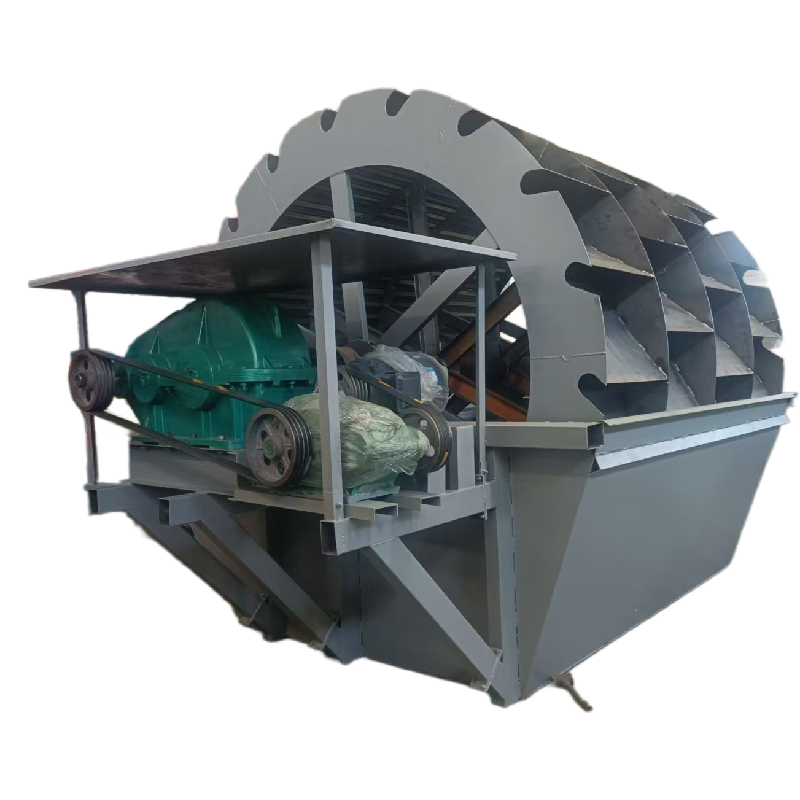
-

Flat Mode Electric Diesel Pellet Granulating Machine Biomass Feed Processing Equipment For Animal
Company Profile Customer Visit Overseas Delivery Exhibition Feedback -

Efficient Cutting Suitable For Large Scale Production Grass Powder Machine Powerful Straw Crusher
A hay cutter is an agricultural equipment specially used to cut plant materials such as hay and silage into small pieces for animal feeding and storage. It achieves fast cutting through efficient knives and feeding systems, saving time and labor. Hay cutters usually have the function of adjustable cutting length to meet the needs of different animals. They are widely used in the breeding industry to help improve feed utilization.
-

Pressure Resistance Briquetting Machine Grass Processing Machine Stable Practical Mixing Machine Hot Sale Uniform Briquetting
A briquetting machine is a device used to compress loose materials into dense blocks or spheres. It is widely used in industries such as biomass, metal, coal powder, and mineral powder. It compresses large waste, powder or granular materials into regular shapes through different methods such as hydraulic, mechanical or high pressure, so as to facilitate transportation, storage or subsequent processing. The briquetting machine can not only improve the utilization rate of materials and reduce the volume of waste, but also reduce transportation and storage costs and improve production efficiency.
Depending on the material, briquetting machines can be divided into biomass briquetting machines, metal briquetting machines, coal powder briquetting machines and other types. The equipment has a compact design and a solid structure. It usually adopts automatic control and has the characteristics of high efficiency, energy saving and durability. During operation, the briquetting machine uses high pressure to make the materials tightly combined, and the molding effect is good. The pressed block material has high density and high strength, which is conducive to subsequent processing or direct application.
The briquetting machine not only saves resources and improves efficiency in industrial production, but also has good environmental benefits. By briquetting waste materials, the discharge of waste is reduced, which meets the requirements of green environmental protection in modern production and is an important equipment in the sustainable development production system.